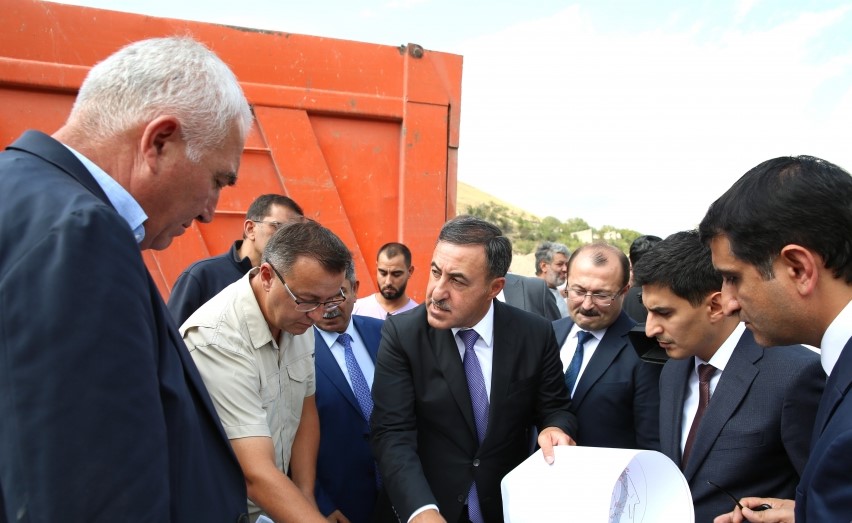
Kalbajar hosted a meeting on Urban Development Issues and Residential Neighborhoods
On September 7, the next meeting of the Urban Planning Working Group of the Inter-Departmental Center, which was created for the centralized resolution of issues in the liberated territories of the Republic of Azerbaijan, was held in the city of Kalbajar. The event was attended by the first deputy chairman of the State Committee on Urban Planning and Architecture of the Republic of Azerbaijan, Namig Hummetov, Masim Mammadov, the special representative of the President of the Republic of Azerbaijan in Lachin district, which is included in the East Zangezur economic district, Nusrat Suleymanov, the head of the secretariat of the Inter-Administrative Center, and representatives of the institutions represented in the Working Group on Urban Planning issues.
At the meeting chaired by the first deputy chairman of the State Committee on Urban Planning and Architecture of the Republic of Azerbaijan, Namig Hummetov, detailed information was given about the urban planning activities and design works in Kalbajar district, the planning of the internal road-street network, the provision of electricity and water to residential areas, as well as the restoration of other infrastructure facilities. issues to be addressed and the development of the tourism potential of the region were discussed. The First Deputy Chairman of the Committee noted that it is a gratifying thing that the meetings of the working group are held in cities that have already been freed from occupation and emphasized that the meeting was held in Kalbajar for the first time.
It was reported at the meeting that the master plan for Kalbajar city is currently in agreement with the relevant state institutions. In accordance with the development concept based on the instructions of the country's administration, the infrastructure of the district is being rapidly renewed. This year, the head of state laid the foundations of the first residential neighborhood in Kalbajar city, a high school building with 960 students, as well as Zar, Zallar, and Yanshag villages in the region. In addition to the design described above, a hotel complex and a water production plant are being built in the Istisu settlement.
According to the current plan, in 2023, 7 more residential areas will be designed in Kalbajar district, and in 2024, 4 residential areas will be designed. In total, 15 settlements, including 1 city, 1 settlement, and 13 villages, will be restored by 2026.
As for infrastructure issues, it was noted that 18.87 km of the road-street network with a total length of 27.08 km is currently being designed in the direction of the construction of the street-road network of settlements in the city of Kalbajar. At the same time, by 2026, approximately 2,000 individual residential houses and 1,500 apartments—a total of 3,500 houses—are expected to be built and put into operation in the Kalbajar region. More than 5,000 people are planned to be relocated to the houses to be built in Kalbajar and 8,000 to villages and towns, totaling 13,000 people.
At the meeting, after giving information about the works carried out in the territory of Kalbajar, relevant tasks were given during the discussions on the issues planned to be done in the upcoming period.
Later, the representatives of the institutions represented in the working group on urban planning inspected the first residential neighborhood under construction in Kalbajar.